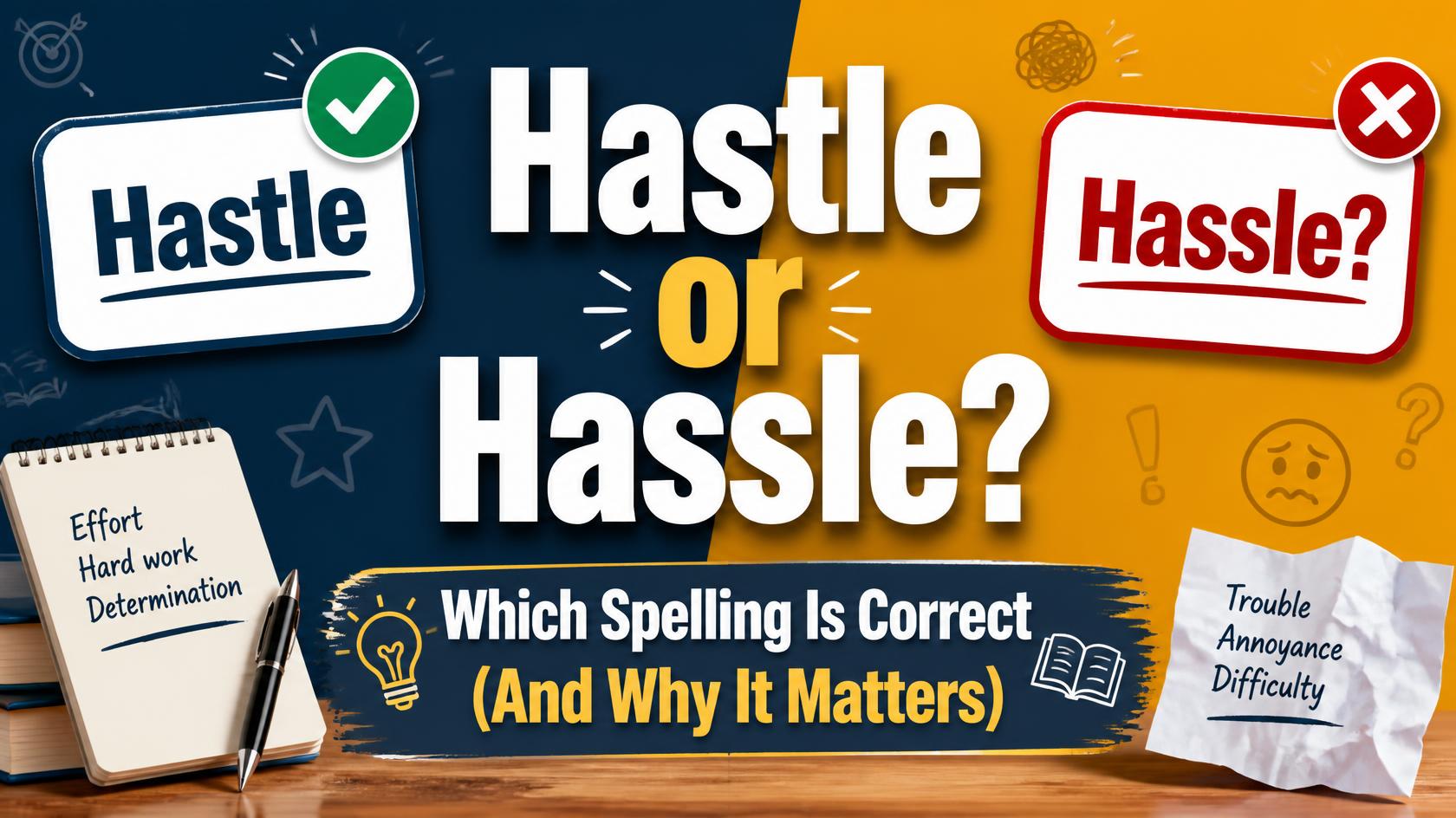
Hastle or Hassle is a common spelling question for English writers. These two words look similar, but only one is correct. The correct spelling is Hassle. It can describe a problem, inconvenience, or annoying situation. You may see the wrong spelling in texts, emails, blogs, or social media. This can happen because the word sounds simple when spoken. A quick spelling check can help you avoid this common mistake.
Learning the difference between Hastle or Hassle can make your writing clearer and more accurate. Hassle can also be used as both a noun and a verb. You might talk about a hassle at work or say someone is hassling you. Understanding the meaning and usage makes the word easier to remember. This guide explains the correct spelling, meaning, examples, pronunciation, and common mistakes. It also shows how to use Hassle naturally in everyday English.
The Correct Spelling: Hassle (Not Hastle)
The correct spelling is hassle. If you mean trouble, inconvenience, or annoying effort, use hassle.
The spelling hastle isn’t the standard English form of this word. It usually appears because someone writes the word the way they think it sounds.
| Spelling | Correct? | Meaning |
| Hassle | ✅ Yes | Trouble, inconvenience, or annoyance |
| Hastle | ❌ No | Common spelling error |
For example:
“Finding a parking space was a hassle.”
Not:
“Finding a parking space was a hastle.”
The difference is only one letter. Still, that small t changes a correct word into a misspelling.
Remember:
- Hassle has two s’s.
- It has no t.
- It works as both a noun and a verb.
- Spellcheck usually helps, but don’t rely entirely on autocorrect.
- Check a dictionary when you’re unsure.
Correct spelling improves writing clarity and makes your written communication easier to trust.
Read More: Unphased or Unfazed? Here’s the Real Answer (2026)
What Does “Hassle” Actually Mean?
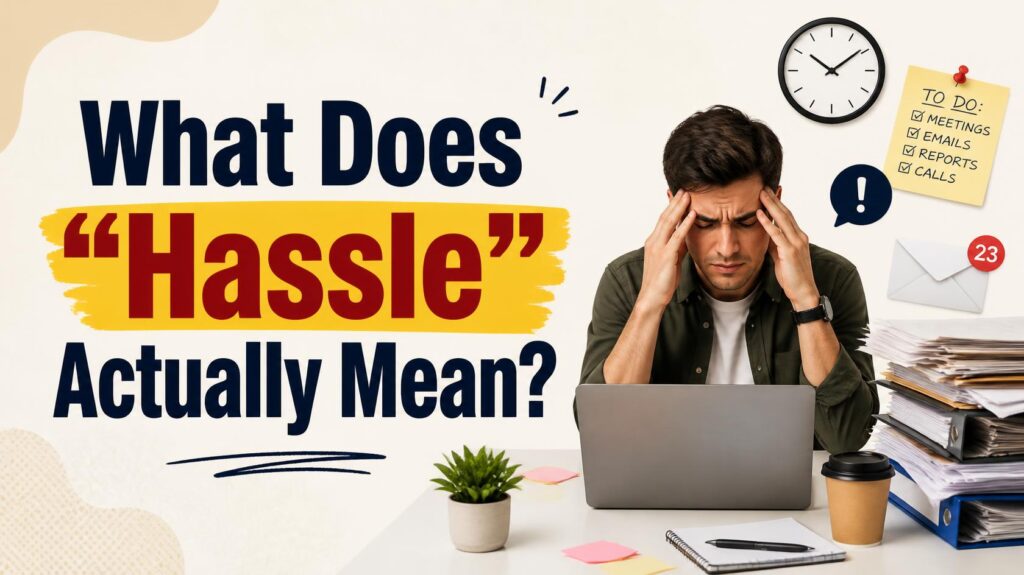
Hassle means an annoying problem, inconvenience, or situation that requires extra effort.
The word usually describes something frustrating rather than something truly dangerous or serious. Think of it as a small obstacle that gets in your way.
For example:
“Getting a refund was such a hassle.”
The speaker isn’t necessarily facing a major crisis. The process simply took too much time, effort, or patience.
Hassle can also mean to bother or pressure someone.
“Stop hassling me about the report.”
Here, hassle works as a verb. The person feels annoyed because someone keeps bothering them.
Common meanings include:
- An annoying inconvenience
- Unwanted effort
- A frustrating process
- Repeated bothering
- Unnecessary difficulty
You might hear the word in casual speech, emails, blogs, advertisements, and everyday conversations.
For instance:
Friend: “Did you get the tickets?”
You: “Yes, but buying them online was a hassle.”
That sounds natural and conversational.
Hassle as a Verb
When hassle acts as a verb, it means to bother, annoy, pressure, or repeatedly trouble someone.
You normally use it with a person or group as the object.
“Don’t hassle your brother.”
“The customers hassled the manager about the delay.”
The verb can describe anything from mild annoyance to persistent pressure. The exact meaning depends on the situation and tone.
Common verb forms
- Present: hassle
- Third-person singular: hassles
- Past tense: hassled
- Present participle: hassling
Notice the spelling of hassling. The word keeps the double s.
Conversation example
A: “Why are you still working?”
B: “My supervisor keeps hassling me about the deadline.”
Here, the speaker isn’t describing a physical problem. Someone is putting pressure on them.
In casual conversation, hassle sounds natural. In highly formal academic writing, you may prefer words such as pressure, disturb, or harass, depending on the intended meaning.
Hassle as a Noun
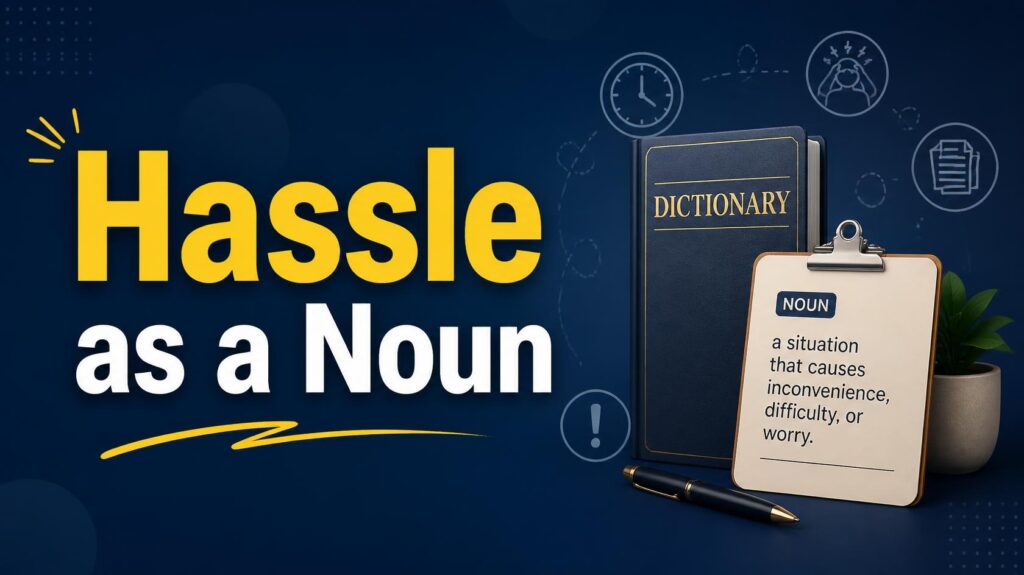
As a noun, hassle describes something that causes inconvenience, frustration, or extra effort.
You can use it for everyday situations that become more difficult than expected.
“Moving to a new apartment was a hassle.”
“Filing the paperwork was a real hassle.”
The noun often appears with words such as a, big, real, major, or unnecessary.
Useful combinations
- a hassle
- a big hassle
- a real hassle
- too much hassle
- avoid the hassle
- save yourself the hassle
- go through the hassle
Conversation example
A: “Why didn’t you order online?”
B: “The return process is too much hassle.”
Here, the speaker focuses on the inconvenience involved.
Unlike problem, which can describe serious situations, hassle often carries a lighter and more conversational tone.
That’s why you’ll frequently encounter it in everyday conversations, customer service messages, blogs, emails, and advertising.
Common Sentence Structures Using “Hassle”
Understanding common sentence structures makes hassle easier to use correctly.
As a noun, you can say:
“Getting a visa can be a hassle.”
“The paperwork was a huge hassle.”
“I don’t want the hassle of returning it.”
As a verb, you can say:
“Don’t hassle me while I’m working.”
“The reporters hassled the celebrity.”
You can also use hassle-free as a common adjective.
“We provide a hassle-free return service.”
Useful patterns
- It is a hassle to + verb
- A hassle to + verb
- The hassle of + noun/gerund
- Hassle someone about + topic
- Avoid the hassle of + noun/gerund
- Hassle-free + noun
Quick conversation
A: “Should we drive downtown?”
B: “Parking there is such a hassle.”
A: “Then let’s take the train.”
These sentence patterns appear frequently in natural English. Learning them gives you more than a dictionary definition. It helps you understand how people actually use the word.
Etymology: Where Did “Hassle” Come From?
The exact origin of hassle isn’t completely certain. English dictionaries generally describe its history as uncertain or dialect-related.
The word became established in English during the 19th century. Some etymological discussions connect it with dialect forms associated with rough handling, argument, or disturbance.
That history doesn’t give us a perfect spelling rule. Still, it provides useful background about how the modern word developed.
One important point remains clear: the standard modern spelling is hassle.
Why etymology helps
Understanding word history can make vocabulary more interesting.
It can also help explain why English contains unusual spellings. Many everyday words developed through several languages, dialects, and historical sound changes.
However, don’t use etymology alone to guess spelling. A reliable dictionary remains the better reference for spelling accuracy and correct usage.
If you’re checking a difficult word, look at both its definition and example sentences. That gives you context as well as the correct form.
Why People Misspell Hassle as Hastle
The Hastle or Hassle confusion is understandable. The two spellings look and sound close.
The biggest reason involves phonetic confusion. People often try to spell unfamiliar words according to the sounds they hear.
When someone hears hassle, they may expect a spelling pattern similar to words such as castle.
Other reasons include:
- Hearing the word before seeing it written
- Typing quickly on a phone
- Relying on pronunciation
- Autocorrect mistakes
- Limited exposure to the written word
- Confusing it with similar-looking words
English spelling contains many patterns that don’t follow simple pronunciation rules. That’s why spelling from sound alone can cause trouble.
A simple example
Incorrect: “This paperwork is such a hastle.”
Correct: “This paperwork is such a hassle.”
The mistake doesn’t change the intended meaning. Still, it can distract readers.
In professional writing, proofreading and spellcheck can catch many common errors before you publish or send something.
Hassle vs. Similar Words (And When to Use Each)
Hassle overlaps with words such as trouble, inconvenience, annoyance, difficulty, and problem. However, these words aren’t always interchangeable.
| Word | Typical meaning | Example |
| Hassle | Annoying inconvenience or effort | “The paperwork was a hassle.” |
| Trouble | Difficulty or a problematic situation | “We had trouble finding the address.” |
| Inconvenience | Something that disrupts comfort or convenience | “We apologize for the inconvenience.” |
| Annoyance | Something that causes irritation | “The noise was an annoyance.” |
| Difficulty | Something that isn’t easy to accomplish | “She had difficulty opening the file.” |
| Problem | A matter requiring attention or a solution | “We have a problem with the order.” |
The right word depends on the situation and tone.
For example, inconvenience sounds more polite and formal:
“We apologize for the inconvenience.”
Meanwhile, hassle sounds more conversational:
“Sorry for the hassle.”
That distinction matters in customer service, professional writing, and everyday communication.
Is “Hassle” Formal or Informal?
Hassle is generally conversational and somewhat informal. However, that doesn’t mean you must avoid it in every professional setting.
You’ll often see it in business emails, marketing copy, customer service communication, and workplace conversations.
For example:
“We want to make the registration process hassle-free.”
That sounds perfectly natural.
In a highly formal academic, legal, or technical document, a more precise alternative may work better.
Consider these alternatives:
- Hassle → conversational
- Inconvenience → polite and formal
- Difficulty → neutral
- Problem → broad and neutral
- Complication → formal and specific
Compare:
“Renewing the license was a hassle.”
with:
“Renewing the license caused considerable inconvenience.”
Both sentences work. The second simply sounds more formal.
Your choice should match the tone, audience, and purpose of your writing.
Hassle in Modern Culture and Media
The word hassle appears frequently in everyday media. You’ll find it in conversations, headlines, advertising, blogs, television, and social media.
Advertisers especially like the word because it quickly communicates frustration.
You may see phrases such as:
- “Skip the hassle.”
- “Save time and avoid the hassle.”
- “A hassle-free experience.”
- “No more hassle.”
- “Make travel hassle-free.”
These expressions work because most people understand the feeling immediately.
Imagine an advertisement saying:
“Book your appointment online and avoid the hassle of waiting.”
The message feels direct and relatable.
In movies and TV shows, characters may also use hassle when talking about annoying situations or someone who keeps bothering them.
Because the word sounds conversational, it fits dialogue particularly well.
Its frequent appearance across modern media also helps reinforce the correct spelling: hassle, not hastle.
Tips to Remember the Correct Spelling of Hassle
If Hastle or Hassle keeps causing confusion, use a simple memory trick.
Think of hassle as a word with two S’s and zero T’s.
Hassle = SS, no T
Another useful trick connects the spelling with its meaning. A hassle can be stressful or annoying, so think:
“Two S’s for stress.”
You can also remember this comparison:
castle → remove the T → hassle
That isn’t an etymological rule. It’s simply a memory device.
More ways to remember
- Write hassle in a sentence several times.
- Read the word in reliable articles.
- Add it to your vocabulary notes.
- Watch for the spelling when reading emails.
- Check a dictionary when uncertain.
- Don’t blindly trust autocorrect.
For example, write:
“I don’t need the hassle.”
After seeing that pattern repeatedly, the correct spelling becomes much easier to recall.
Quick Proof Checklist: Hassle or Hastle?
Before publishing or sending your writing, take a quick look at the word.
If you mean trouble, inconvenience, annoyance, or unwanted effort, check the spelling carefully.
Quick checklist
- Did you write hassle?
- Did you accidentally add a t?
- Does the word mean inconvenience or annoyance?
- Are you using it as a noun or verb?
- Does the sentence sound natural?
- Does the tone suit your audience?
- Did spellcheck flag anything?
- Should you confirm the word in a dictionary?
Quick test
Wrong: “What a hastle!”
Right: “What a hassle!”
Wrong: “Stop hastling me.”
Right: “Stop hassling me.”
Wrong: “We offer a hastle-free service.”
Right: “We offer a hassle-free service.”
A few seconds of proofreading can prevent a simple typing error from reaching your reader.
FAQs:
Q1: Is Hastle ever correct?
No, Hastle is not the standard spelling for this word.
In Hastle or Hassle, always choose Hassle when you mean trouble or inconvenience.
Q2: What contexts can I use Hassle in?
Hassle works well in conversations, emails, blogs, texts, and social media.
In Hastle or Hassle, use Hassle for everyday inconvenience or annoyance.
Q3: How can I avoid confusing Hassle and Hastle?
Remember that Hassle has two s letters and no t.
When checking Hastle or Hassle, choose Hassle for correct spelling.
Q4: Does misspelling Hassle affect credibility?
Repeated spelling mistakes can weaken reader trust and create a less professional impression.
Choosing Hassle correctly keeps your writing clear and polished.
Q5: Are there tips for correct usage?
Remember Hassle means inconvenience as a noun and bothering someone as a verb.
For Hastle or Hassle, remember Hassle has two s letters.
Conclusion
The answer to Hastle or Hassle is simple: Hassle is the correct spelling. Hastle is a common spelling error that can appear in casual writing, texts, emails, and social media. Knowing the correct form improves your spelling accuracy and writing clarity. Hassle can work as both a noun and a verb. It usually describes trouble, inconvenience, annoyance, or difficulty. Once you understand its meaning, the correct spelling becomes easier to remember.
When you check Hastle or Hassle, always choose Hassle when you mean an inconvenience or something annoying. A simple spelling habit can prevent common errors and improve your professional writing. Remember that Hassle has two s letters and no t. Keep this rule in mind when proofreading. Whether you are writing an email, blog, message, or academic text, choosing Hassle helps your writing look clear, accurate, and confident. For Hastle or Hassle, Hassle is always the right choice.