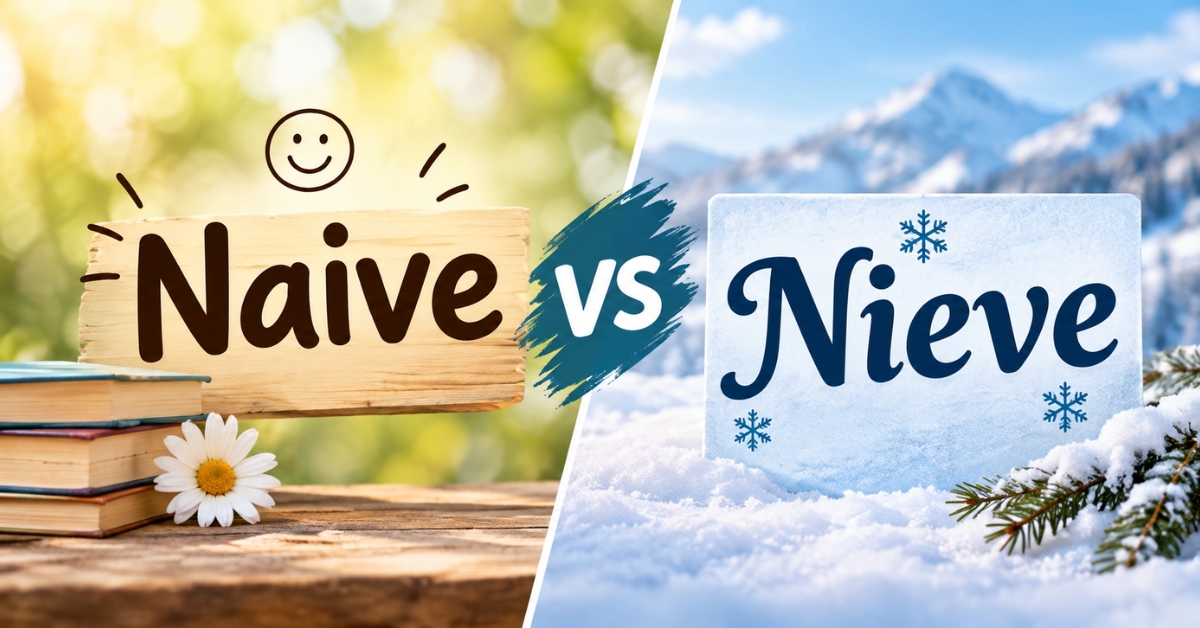
You’ve probably typed “nieve” instead of “naive” at least once. It happens more than you think.
Here’s the truth. Naive is the correct English word. Nieve is actually Spanish, and it means snow. Two totally different words, two totally different languages.
So why do people mix them up? Simple. They sound almost the same when spoken fast. Your brain hears “nah-eev” and grabs the nearest familiar spelling. That’s where the mistake sneaks in.
This guide breaks down Naive vs Nieve in plain terms. You’ll learn where naive comes from, what it really means, and why nieve doesn’t belong in your English writing. No confusing grammar talk. Just clear answers you can use right away, whether you’re writing an email, an essay, or a text to a friend.
My Quick Answer
The correct spelling is naive. Not nieve.
I’ve seen this word butchered in emails, essays, and even published articles. So let’s clear it up right now, no waiting around.
Naive means lacking experience, being too trusting, or showing simplicity in judgment. It comes from French, and you can write it as naive or naïve, both work fine in English.
Nieve isn’t wrong because it’s rude or offensive. It’s wrong because it’s not an English word at all. It’s actually a Spanish word that means snow. So if you’re writing in English and you type nieve, you’ve accidentally switched languages on yourself.
Also Read : Put or Puts? A Simple Trick to Never Mess Up 2026
Why I Found It’s Spelled “Naive”
I dug into this because I kept seeing the same question pop up again and again: why does naive have that specific spelling? Turns out, the answer is pretty simple once you see it.
English spelling rules borrow heavily from other languages, and naive is a textbook example. The word didn’t originate in English. It walked in from another language entirely, and it brought its original spelling along for the ride.
That’s the short version. But there’s a specific story behind it, and once you know it, you won’t forget the correct spelling again.
The French Connection I Discovered
Naive comes straight from French. The French word is “naïve” (feminine form of “naïf”), and English speakers borrowed it pretty much as is.
Here’s the part that trips people up. In French, that little mark over the “i” is called a diaeresis. It tells you to pronounce the “i” and the “e” as separate sounds, not blended together.
In English, that mark is optional. You’ll see naive written without it constantly, especially in casual writing, news articles, and everyday emails. Formal or academic pieces sometimes keep the naïve version out of respect for its French origin, but honestly, both are accepted.
What matters is the correct spelling with an “a”. That’s the non negotiable part. The diaeresis is just decoration by comparison.
My Definition and Meaning Analysis
So what does naive actually mean? Let’s break it down properly, because dictionary definitions can feel a bit stiff.
At its core, naive describes someone showing a lack of experience, lack of wisdom, or lack of judgment about how the world actually works. Think of someone who takes everything at face value, no questions asked.
It also covers being too trusting. Picture a coworker who hands over their password because “the email looked official.” That’s a naive move, not because they’re dumb, but because they didn’t stop to question it.
Naive can describe someone as inexperienced or unsophisticated in a specific area. You can be a brilliant surgeon and still be naive about investing your money. The word is situational, not a permanent label.
There’s a softer side too. Naive sometimes just means innocent or unaffected by cynicism. A kid who believes strangers are automatically kind isn’t foolish, they’re simply unsuspecting because they haven’t learned to apply critical thinking to every interaction yet.
As for part of speech, naive works as an adjective. You’ll also run into naive functioning as a describing word for people, plans, ideas, or even entire strategies.
Also Read : Put or Puts? A Simple Trick to Never Mess Up 2026
Naive vs Nieve: My Comparison Table
Sometimes a table clears things up faster than paragraphs ever could. Here’s my side by side breakdown.
| Feature | Naive | Nieve |
| Language | English (from French) | Spanish word |
| Meaning | Lack of experience, too trusting | Nieve means snow |
| Correct in English? | Yes | No, this is a common misspelling |
| Part of speech | Adjective | Noun (in Spanish) |
| Pronunciation | nah EEV | nee EH veh |
| Used in | English writing, essays, business docs | Spanish sentences only |
That table alone should settle most arguments. If you’re writing an English sentence, nieve simply doesn’t belong there.
Examples I Use in Different Contexts
Reading a definition is one thing. Seeing the word in action is where it actually clicks. Here’s how I use it across different settings.
Professional Context:
“It would be naive to launch this product without testing it first.”
“Her naive approach to negotiations cost the company a better deal.”
Personal Context:
“I was pretty naive about relationships in my early twenties.”
“Don’t be naive, that deal sounds way too good to be true.”
Academic Context:
“The study criticized the researcher’s naive assumptions about human behavior.”
“Naive realism is a common topic in introductory psychology courses.”
Incorrect Examples (What NOT to Write):
“I was so nieve about how contracts work.” (This should read naive.)
“Don’t be so nieve, check the facts first.” (Again, naive is the correct spelling.)
If you catch yourself typing nieve in an English sentence, pause. Your spell checker probably will too.
Common Related Words I Found
Naive doesn’t travel alone. It comes with a small family of related words, and knowing them makes your writing sound sharper.
Naively is the adverb form. Use it when describing how someone acted, not what they are. For example, “He naively agreed to the terms without reading them.”
Naivety and naiveté are both noun forms describing the quality of being naive. Naiveté keeps its French spelling flavor, while naivety feels more casually English.
Usage Examples of Related Words
“She acted naively when she trusted the stranger’s promise.”
“His naivety about office politics got him into trouble.”
“There’s a certain charm in youthful naiveté, even if it’s risky.”
Mixing these forms into your writing shows range. It also signals to readers, and to search engines, that you actually understand the word instead of just repeating it.
Why People Make the “Nieve” Mistake
This confusion isn’t random. There are real reasons behind it, and once you see them, the mistake almost makes sense.
Phonetic confusion is the biggest culprit. English speakers hear “nah EEV” and their brain reaches for familiar spelling patterns. Words like believe, relieve, and retrieve all use that “ie” pattern, so people instinctively borrow it for naive too.
Spanish influence plays a role as well. For plenty of people, nieve means snow in Spanish, and it’s a word they’ve seen written plenty of times. When two languages share similar sounding words, our brains sometimes grab the wrong one.
There’s also a visual pattern issue. The letters just look similar enough at a glance that autocorrect, tired eyes, or quick typing can slip the wrong version into a sentence.
None of this means you’re careless. It just means English spelling can be sneaky, especially with borrowed words.
Memory Tip I Use
Here’s the trick that stuck with me. Naive starts with “na,” just like “naive person is not aware.” Both start with “na.” That tiny link is enough to lock it in.
Another one that works well: nieve has snow hiding inside it if you squint (nieve, believe it means snow in Spanish). If you’re picturing snow, you’re picturing the wrong word for an English sentence.
Naive in Different Fields
Naive isn’t just a casual word. It shows up in some pretty technical corners too, and the meaning shifts slightly depending on where you find it.
In computer science, a naive algorithm refers to the most straightforward solution to a problem, without any clever optimization. It’s often called inefficient because it might run in O(n²) complexity, doing far more work than necessary. Programmers use “naive” here without any insult intended, it just means the basic version.
In mathematics, you’ll bump into naive set theory, an early and simplified approach to understanding sets before more rigorous frameworks were developed.
Psychology has its own version too. Naive realism describes the belief that we see the world exactly as it is, with no bias or filter. Spoiler: nobody actually does that, but plenty of people assume they’re the exception.
Even art and literature borrow the term. Naive art describes work made without formal training, often praised for its raw honesty and cognitive simplicity rather than technical polish.
Formal vs Informal Usage
Should you write naive or naïve? It honestly depends on where you’re publishing.
In formal writing, academic papers, or pieces that lean heavily on French origin spelling traditions, you’ll often see naïve with the diaeresis intact. It signals attention to detail and respects the word’s roots.
In casual conversation, blog posts, texts, and most business communication, plain old naive without any accent marks is completely standard. Nobody will raise an eyebrow.
Journalism tends to favor the simpler naive spelling too, mostly because most keyboards and style guides skip special characters unless absolutely necessary. Academic writing, on the other hand, sometimes keeps the diaeresis for precision.
Bottom line, pick one and stay consistent throughout your document. Switching back and forth mid page looks like an accident, not a stylistic choice.
Is Naive an Insult?
This question comes up a lot, so it deserves its own space. Naive can sting a little, but it’s rarely meant as a full blown insult.
Calling someone naive usually points at inexperience or misplaced trust, not stupidity. There’s a real difference. A naive plan might just need more research behind it, not a complete rewrite from scratch.
Context changes everything here. “That’s a naive take on the economy” sounds like a critique. “You were young and naive” sounds almost affectionate, like forgiving someone for not knowing better yet.
Explore More Grammar Guides
If sorting out naive versus nieve scratched an itch, there’s a good chance other commonly confused word pairs will catch your interest too. English is full of these little traps, words that sound alike, look similar, or came from different languages but somehow ended up looking like cousins.
Keep an eye out for guides covering affect versus effect, lose versus loose, or compliment versus complement. They follow the same pattern as naive and nieve, small differences with big consequences for how your writing reads.
Frequently Asked Questions
Why is naive spelled with an a?
Because it comes from French, where “naïve” uses that spelling. English kept the correct spelling with an “a” when it borrowed the word.
What does naive mean?
It describes someone showing lack of experience, lack of judgment, or being too trusting and unsophisticated about certain situations.
Can you spell it naive or naïve?
Both are accepted. Naïve includes the diaeresis from its French origin, while naive drops it for simplicity. Neither is technically wrong.
Is nieve a word in English?
No. Is nieve a word in English is a common search, but the honest answer is no, it’s purely Spanish.
What’s the difference between naive and innocent?
Innocent usually implies moral purity or lack of guilt. Naive leans more toward lack of wisdom or judgment about how things actually work, without the moral angle.
How do you use naive in a sentence?
Try something like, “It would be naive to assume the meeting will run on time.” Simple, direct, and grammatically sound.
What part of speech is naive?
It’s an adjective. The related adverb is naively, and the noun forms are naivety and naiveté.
Why do people spell it nieve?
Mostly phonetic confusion, Spanish influence, and a similar looking visual pattern to words like believe and relieve.
Conclusion
So there you have it. The Naive vs Nieve debate isn’t really a debate at all. Naive is correct. Nieve means snow in Spanish. That’s the whole story.
Next time you’re unsure, just remember this. Naive vs Nieve comes down to one simple rule. If you’re writing in English, choose naive. Every single time. Nieve just doesn’t belong in your sentence, no matter how similar it sounds.
Spelling mistakes happen to everyone. But now you know the fix. The Naive vs Nieve mix-up won’t trip you up again. You’ve got the meaning, the origin, and the memory trick to back you up.