Is it spicey or spicy? I see this mix-up everywhere. Texts, reviews, blog posts, even menus get it wrong. So I decided to dig in and check it myself. I looked at dictionaries. I checked grammar rules. I read real examples from real writing. I wanted a clear, simple answer. Not a long, boring grammar lecture.
Here’s the short version. Only one spelling is correct in English. The other one is just a common typo that stuck around. Once you learn the simple rule behind it, you’ll never mix them up again. No confusing terms. No grammar jargon. Just plain English you can actually use. This guide walks you through the rule, real examples, and easy tips to remember it. By the end, you’ll spell it right every single time.
My Quick Answer
Spicy is the correct spelling in standard English. Spicey is a common misspelling, even though it shows up a lot online. If you remember one thing from this whole article, remember that.
Why I Found It’s Spelled “Spicy”
English has a habit of dropping letters when you add endings to a word. The base word here is spice, and it already ends in a silent e. When you turn it into an adjective, that silent e has to go.
You’re left with spic-, and then you tack on a -y. That gives you spicy, clean and simple, no extra letters needed. Every major dictionary, from Merriam-Webster to Oxford, backs this up.
Read More: Shiney or Shiny? I Finally Found the Answer 2026
The “Drop the E and Add Y” Rule I Follow

I think of it as a mental shortcut: drop the silent e, add y, done. This isn’t some random exception either, it’s part of a bigger spelling pattern. Tons of English words follow the exact same word transformation.
Think about ice becoming icy, or price turning into pricy. The silent vowel disappears, the suffix -y steps in, and the new word feels natural. Once this clicks, you’ll stop second-guessing yourself on words like this.
My Definition and Meaning Analysis
“Spicy” isn’t a one-note word, and that’s part of why people misuse it. I broke down the main ways I’ve seen it used across writing and conversation. Here’s what each meaning actually looks like in practice.
1. Food with Heat
This is the meaning everyone thinks of first: hot food that burns a little. We’re talking chili peppers, hot sauce, and anything with real heat level. A dish loaded with jalapeños or gochujang easily earns this label.
2. Flavorful and Seasoned
Sometimes “spicy” just means well-seasoned, not necessarily hot at all. A curry can be described as spicy because of its bold spice blend, not its burn. This is where flavorful and pungent overlap with the word.
3. Exciting or Lively
Outside the kitchen, spicy describes anything exciting or full of energy. A spicy conversation at a dinner party isn’t about food, it’s about drama. People use it to describe stimulating debates, arguments, or plot twists.
4. Slightly Scandalous
The most playful meaning: something a bit risqué or edgy. A spicy joke pushes boundaries a little, without being outright inappropriate. You’ll see this in spicy gossip, spicy rumors, or a raunchy movie scene.
The Pattern: Similar Word Transformations
Once I noticed the spice-to-spicy shift, I started spotting it everywhere. It’s not a one-off rule, it’s a whole family of similar changes. Here are a few I ran into while researching this.
- Ice → Icy (drop the e, add y)
- Price → Pricy (same silent e drop)
- Space → Spacious (a related but slightly different suffix pattern)
- Dice → Dicey (an interesting near-exception, more on that below)
Why This Pattern Makes Sense
English hates having two vowel sounds crash into each other awkwardly. Dropping the silent e before adding a vowel-starting suffix keeps pronunciation smooth. That’s really the whole logic behind this spelling rule.
It also keeps things consistent, which is honestly rare for English. Once you know the pattern, you can predict a dozen other words correctly. That’s why grammar teachers love using spicy as a teaching example.
Spicy vs Spicey: My Visual Comparison
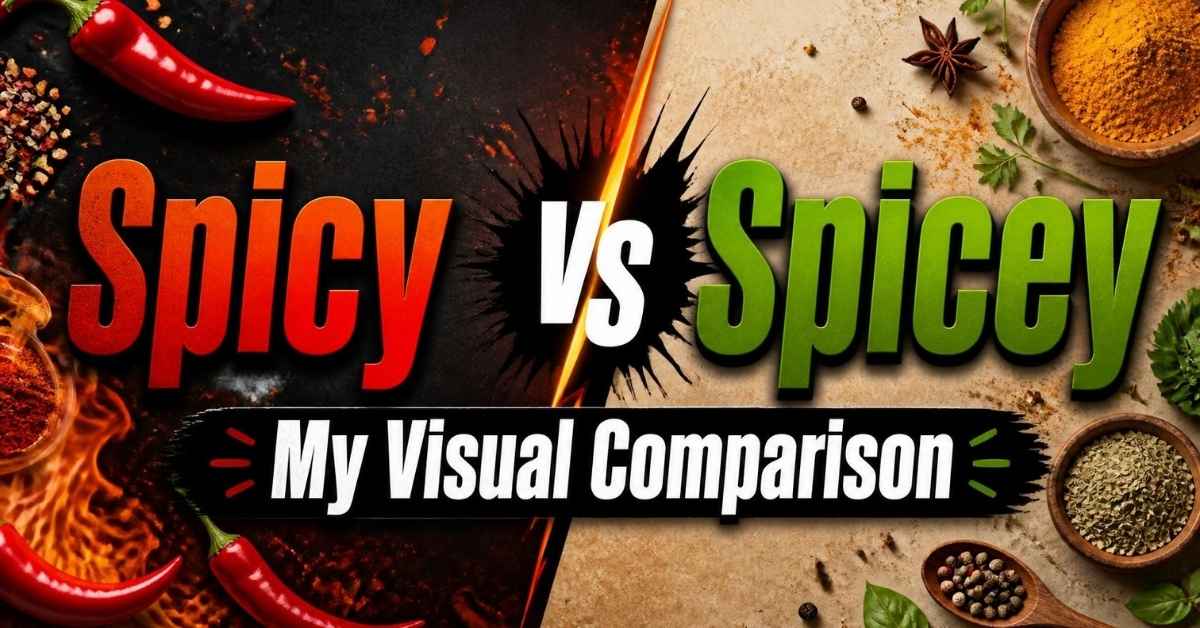
| Feature | Spicy | Spicey |
| Standard English spelling | Yes | No |
| Dictionary listed | Yes, primary entry | Rarely, sometimes as informal variant |
| Follows silent-e rule | Yes | No |
| Common in formal writing | Yes | No |
| Common in casual typos | No | Yes |
Real-World Examples I Use

Seeing a word in context always helps it stick better than a definition alone. I pulled together examples across different writing styles and tones.
Culinary and Food Examples:
- “This spicy curry cleared my sinuses in one bite.”
- “The restaurant menu listed three heat levels for their wings.”
- “Her food blog review called the taco sauce pleasantly spicy.”
Informal and Creative Examples:
- “That comment section got a little spicy real quick.”
- “Their new single has a spicy guitar riff that hits different.”
- “He dropped a spicy take on social media and regretted it instantly.”
Professional and Descriptive Examples:
- “The report included some surprisingly spicy commentary on the merger.”
- “Our marketing copy needed a spicy hook to grab attention.”
- “The panel discussion turned spicy once the topic shifted to layoffs.”
Examples of What NOT to Write:
- ~~”This dish is way too spicey for me.”~~ Should be spicy.
- ~~”Her spicey comment shut the room up.”~~ Should be spicy.
- ~~”I love spicey food more than sweet food.”~~ Should be spicy.
Pronunciation Guide I Use
Spelling and pronunciation don’t always match in English, but this one’s fairly simple. Both “spicy” and the misspelling “spicey” are said the exact same way out loud. That’s actually part of why the typo happens so often.
Phonetic Pronunciation
The pronunciation of spicy is written as /ˈspaɪ.si/ in phonetic notation. Say it out loud and you’ll hear SPY-see, with two syllables total. The primary stress lands hard on that first syllable, SPY.
Read More: Is Good Morning Two Words? Don’t Get It Wrong 2026
Spicy vs Spicey: My Summary Table
| Question | Answer |
| Correct spelling? | Spicy |
| Incorrect spelling? | Spicey |
| Word origin? | From spice, dropping silent e, adding -y |
| Meaning? | Hot, flavorful, exciting, or slightly risqué |
| Used in formal writing? | Yes, spicy only |
Did You Know?
The word “spice” traces back to Old French and Latin roots tied to trade goods. Spices were once so valuable they were practically used as currency in some regions. That history is part of why the word carries so much flavor, literally and figuratively.
Common Mistakes I’ve Learned to Avoid

After reading through dozens of reviews, captions, and blog posts, patterns emerged fast. Here are the three mistakes I saw the most, and how to dodge them.
Mistake #1: Adding Unnecessary Letters
The biggest issue is simply tacking that extra e back onto the word. People assume more letters look more “correct,” but here it’s the opposite. Stick to spicy, no e needed after the silent one gets dropped.
Mistake #2: Confusing with Similar Words
Words like dicey trip people up because they look like a similar pattern. But dice already ends in a consonant sound before the e, so the y attaches differently. Spicy and dicey just happen to rhyme, they don’t share identical spelling logic.
Mistake #3: Inconsistent Spelling
Some writers use spicy in one paragraph and spicey a few lines later. This kills spelling consistency, and it looks unpolished to readers and search engines alike. Pick spicy, and stick with it through the entire piece.
When to Use “Spicy” in Different Contexts
Context changes tone, but it never changes the spelling itself. Here’s how I’ve seen it used correctly across different writing situations.
Food Writing
In culinary articles and recipe books, spicy describes heat and seasoning directly. It’s a go-to word for food reviews and restaurant descriptions everywhere. Readers instantly know what to expect from a dish labeled this way.
Casual Conversation
In text messages and everyday chat, spicy often means exciting or juicy news. “Spill the spicy details” is a phrase you’ve probably heard or used yourself. It’s playful, informal, and works great in casual writing.
Professional Writing
Even in academic writing or journalism, spicy can describe a bold or controversial angle. A spicy op-ed grabs attention because it takes a strong, clear stance. Just keep the tone appropriate for the publication or audience.
Creative Writing
Fiction writers love spicy for describing tension, chemistry, or sharp dialogue. A spicy exchange between characters adds energy to a scene instantly. It’s a small word that does a lot of heavy lifting.
Synonyms and Related Terms I Found
If you want variety in your writing, here are solid alternatives depending on context.
- Piquant – sharp, appetizing flavor
- Zesty – lively and tangy
- Pungent – strong, sharp smell or taste
- Fiery – intense heat
- Provocative – bold or eyebrow-raising in tone
Mixing these in keeps your writing from repeating the same word over and over.
Cultural Context and Spiciness Levels
Spice tolerance and usage shift a lot depending on where you are in the world. I found this part genuinely interesting while researching heat levels across cuisines.
Understanding Spiciness Levels:
- Mild spicy – a light warmth, barely noticeable
- Medium spicy – a steady kick that builds
- Hot spicy – real heat that lingers
- Extra spicy and extreme spicy – for people who actively enjoy the burn
Read More: Time Flies or Time Flys? Here’s the Real Answer 2026
Cultural Differences:
Thai cuisine and Korean cuisine often lean heavily into bold, layered heat. Indian cuisine blends spice for depth as much as for burn. Mexican cuisine brings smoky, chili-forward heat, while Western cuisine tends to stay milder overall.
Pro Tip I Learned
Ask locals or servers about heat levels before ordering something labeled “spicy” abroad. What counts as mild in one culture might floor someone from another. It’s saved me from a few regrettable meals, trust me on this one.
How Major Dictionaries Define Spicy
I checked a handful of trusted dictionaries just to confirm everything above. Merriam-Webster lists spicy as flavored with or fragrant with spice. Oxford adds the secondary meanings tied to excitement and mild scandal.
None of the major dictionaries list “spicey” as a standard writing option. A few informal or crowd-sourced sources mention it as a variant, but that’s it. For anything you’re publishing or submitting, spicy is the safe, preferred spelling.
Explore More Grammar Guides
If this kind of word breakdown helped you, there are plenty more like it out there. Confusing word pairs, silent letters, and spelling rules trip up even strong writers regularly. Bookmarking a few reliable grammar resources can save you from repeat mistakes down the line.
Frequently Asked Questions
Is it spicey or spicy?
It’s spicy. Spicey is a common misspelling and isn’t standard English.
Why is spicy spelled without an e?
Because the base word “spice” already has a silent e, which drops before adding -y.
What does spicy mean?
It can mean hot food, well-seasoned food, something exciting, or something slightly scandalous.
Is spicey ever a correct spelling?
No, not in standard or formal English. Stick with spicy.
How do I remember the correct spelling?
Just remember: drop the e, add y. Spice becomes spicy, the same way ice becomes icy.
What is the pronunciation of spicy?
It’s pronounced /ˈspaɪ.si/, or SPY-see, with stress on the first syllable.
Can spicy be used in formal writing?
Yes, spicy works fine in formal, professional, and academic writing when used correctly.
What are some common synonyms for spicy?
Piquant, zesty, pungent, fiery, and provocative all work depending on context.
How do I use spicy in a sentence?
“The spicy noodles left my mouth burning for a solid five minutes.”
Are there any exceptions to this spelling rule?
Not really for spicy itself, though similar-looking words like dicey follow a slightly different path.
My Final Verdict
So, spicey or spicy? By now, you know the answer. Spicy is correct. Spicey is not. That’s the whole rule in one line. English can be tricky. But this one is simple once you see it. Drop the silent e. Add a y. Spice becomes spicy. Easy, right?
Next time you’re stuck on spicey or spicy, just remember this guide. Think of ice turning into icy. Or price turning into pricy. Spicy follows the exact same pattern. No more guessing. No more typos. No more second-guessing yourself in emails, reviews, or recipes. The debate over spicey or spicy ends here. Spicy wins, every single time. Use it in your writing. Use it in your texts. Use it anywhere you need the right word. You’ve got this one down for good now